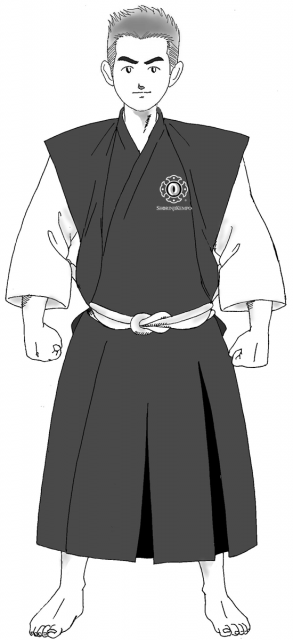
During practice dōgi should be used.
Colour of dōgi shall be white and have breast badge embroidered. Sodeshō (sleeve badge) that indicates branch and possibly function/rank shall be on the left side, the lower part of the arm badge should meet the seam of the sleeve.
Name shall be on the back side of the collar of the dōgi, on the lower part of the front of the dōgi (extension of the collar) and close to the upper part of the dōgi trousers.
Sleeves of the dōgi should not be rolled up and the length should be between elbow and wrist.
Lower part of the dōgi trousers shall be between ankle and knee.
When wearing underwear under dōgi, it must be worn so as not to be visible, use a white t-shirt.
Use a correct obi (belt, varies depending on rank), do not use an obi that are miscoloured or unnecessary worn.
Feet shall be bare if not special circumstances require different.
Dōgi・道衣
Name
Should be on the backside of the dōgi collar, lower part of the front of the dōgi (extension of the collar) and close to the upper edge of the dōgi trousers.
Sleeves
The length of the sleeves should be between the elbow and the wrist.
Trousers
The length of the trousers should be between the knee and the ankle. |
 |
Breast badge
Shall be embroidered on the dōgi.
Sodeshō (Sleeve badge)
① Sleeve badge (may vary depending on title and rank) should be on the upper part of the left sleeve, the lower part of the badge should meet the seam of the sleeve.
② Sleeve badge that indicates rank for shōnenbu (children’s group) should be on the right sleeve’s upper part (in the shape of a V), the upper part of the badge should meet the seam of the sleeve. |
Hōi・法衣
The lower edge of the dōgi trousers shall be in line with the lower edge of the hōi.
The dōgi trousers shall not be viewable below the hem of the hōi. |
 |
|


 Home
Home

 On Saturday the 3rd of December some of us drove to Skövde to train for a full day. It was Anders Pettersson, since he also is shibu-chō for Skövde shibu has to hold gradings and teach a bit, and two additional members from the branch, Daniel Wallberg and Simon Flodin, who went to Skövde this December Saturday.


